Setting Up a Scored Debate Stream Where Your Chat Watches the Rubric Before the First Word Is Spoken
Publish your rubric first so chat can score and challenge the AI judge.

A scored debate stream turns viewers into evaluators by publishing its rubric before anyone speaks. The setup requires live voice or video, visible scoring criteria, timed rounds, and an AI verdict that explains its scores with references to the debate. The decisive feature is not automated judging alone, but a shared standard that lets chat assess the speakers and challenge the judge.
Why live debate audiences shrank and what that opening means for streamers
The audience for televised debate has shrunk by roughly half since 2016. That decline reflects fragmentation. Younger cohorts encounter debates through clips on social platforms, where their clip audiences exceed their live audiences. A streamer therefore competes not only for attention, but for a reason to watch the whole exchange.
Participation gives the live format that reason to exist. A clip offers a statement to react to, while a scored round offers an argument to follow, assess, and compare with a verdict. The opportunity is a smaller, interactive format in which viewers have a concrete task throughout the broadcast.
What the rubric actually does when chat sees it before the debate starts
Publishing the rubric in advance changes what viewers listen for. Instead of deciding only which speaker they like, they can track whether a claim was supported or an objection answered. Debaters also know ahead of time what they need to do to score well. Neither group has to infer the standard from the eventual result.
Chat can mark each criterion during the round, then compare its assessment with the AI verdict delivered seconds after the final speech. Disagreement becomes more precise because viewers can identify a score and the speech that should justify it.
A short example clip helps establish that common ground. Before the live round, viewers can score a student or competitive speech and raise uncertainties about how the criteria apply. This calibration gives the audience practice before its judgments count toward the discussion. The rubric therefore serves both participation and evaluation.
How to design a rubric that works on stream — criteria, scale, and what to leave out
Use a narrow rubric that viewers can track while listening. Argument clarity should measure how plainly and how early the speaker makes the claim, while rebuttal quality should measure how directly the speaker answers the opponent. Evidence use distinguishes supported claims from assertions. Delivery and persuasion capture whether the speaker is comprehensible and compelling.
The Chicago Debates Judge Guide 2025–2026 rewards organization of thought, strategy in extending, defending, and negating arguments, strength of main arguments, teamwork, comparative weighing, explanation of evidence, and persuasiveness. For a typical 1v1 round, omit teamwork scoring and academic-level adjustments. Handle speaking time through a visible countdown.
Prefer a 5-point-per-criterion scale so viewers can keep track of scores in their heads. A 100-point total also works when the full breakdown stays visible, but the extra granularity should not conceal how points were earned. Give each criterion a brief rationale in the verdict. Borrow the World Schools principle of no draws and no low-point wins, so the decision identifies a winner and the margin conveys how close the round was.
Displaying the rubric on screen so chat can score alongside the AI judge
Put the rubric in a persistent overlay or sidebar from the moment the stream opens, before introductions. A splash screen is not enough for ongoing scoring. Viewers need access to the standard while a speaker is making the argument it governs.
Use that display during the opening calibration clip. Ask chat to score the example using the criteria on screen, then discuss where the scores differ before the live debate starts. Place a countdown beside the scoring information so viewers can recognize when a speech ends and a rebuttal window opens.
Give viewers a structured way to record their assessment. Chat commands or polls can map directly to criteria, including a rebuttal-quality prompt with the choices “strong,” “adequate,” and “missed the argument.” When the verdict arrives, display the written breakdown alongside the total. That lets viewers compare their marks with the judge’s reasons on the same screen.
Structuring the round so each speech gives chat something new to evaluate
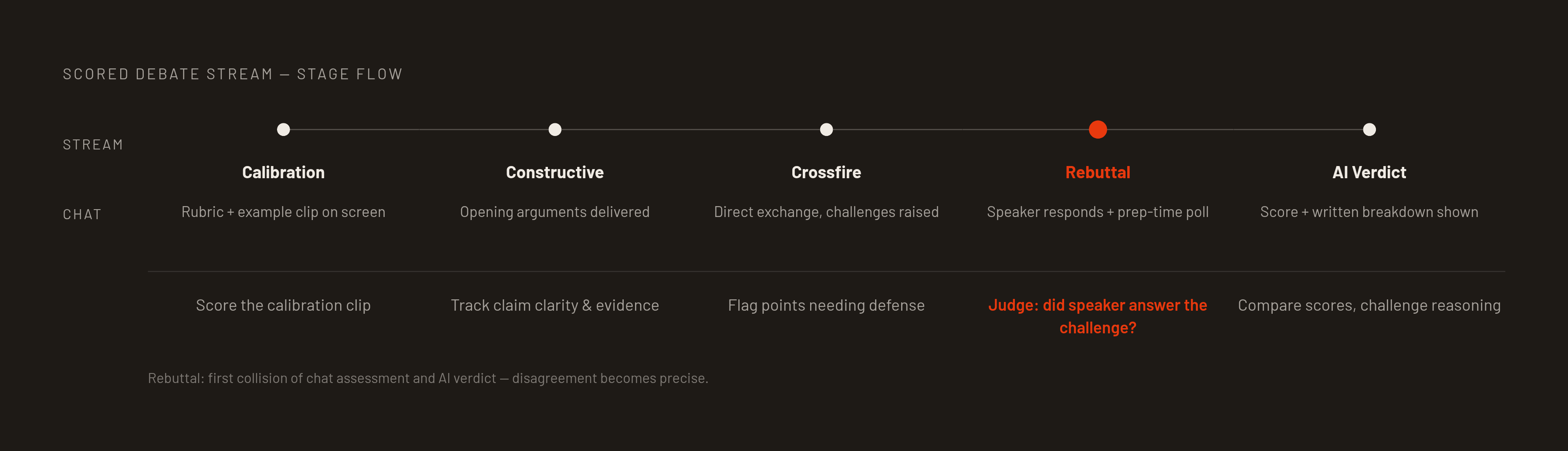
Use formal debate structure as an adaptable model. The Chicago Debates reference shows how to give speakers time to build arguments and challenge them, then leave time for judging. For a 1v1 stream, compress the round into constructive, crossfire, rebuttal, and final focus.
The constructive establishes the claims and supporting evidence. Crossfire exposes points that need clarification or defense, giving viewers material against which to assess the rebuttal. Rebuttal then tests whether the speaker answered the challenge or just repeated the opening position. Final focus is the time for comparative weighing, when speakers explain which issues should decide the round.
Public Forum prep time can also serve the audience. During that pause, post a rubric-mapped poll asking which argument the next speaker will prioritize. Keep those poll results out of the formal decision. The AI judge should assess the cumulative round because an argument’s strength can change as the opponent challenges it.
Picking a topic that gives chat a genuine split to argue about
Choose a contestable value or policy question. “Should rich countries pay poorer ones to cut emissions?” presents trade-offs that opposing speakers can weigh. “Is the Earth warming?” does not serve the same purpose.
Specificity makes the burden of proof easier to follow. “Technology is bad” leaves the affected people, proposed change, and context unclear, while “This house would ban smartphones for students under 14 during the school day” defines them. Before selecting the motion, write three real reasons for each side. If one side cannot sustain that test, the round is likely to be lopsided.
Competitive phrasing can make those burdens explicit without lengthy explanation. “This house would (THW)” introduces a policy change, such as “THW ban homework.” “This house believes (THBT)” introduces a value claim. “This house regrets (THR)” frames a retrospective topic.
Randomly assign the “for” and “against” positions. That challenges both speakers to build a case. Before the round, poll chat on the motion with “for,” “against,” and “unsure” options. The initial split gives the persuasion discussion a baseline and shows where the burden of changing minds sits.
How the AI judge produces a scored verdict and what makes that verdict trustworthy to chat
An AI judge scores arguments against predefined criteria such as clarity, relevance, evidence, and rebuttal strength. Its consistency advantage is applying the same rubric throughout the round without human fatigue or distraction. That advantage does not make the verdict self-validating. Viewers still need to see how the system connected a particular speech to a particular score.
A trustworthy breakdown cites specific moments in the debate. A low rebuttal score, for example, should be explainable against what the opponent argued and how the speaker responded. Chat can then challenge whether a direct answer was overlooked. A total without that rationale provides a result, but no practical basis for examining it.
The strongest objection is that AI can penalize unconventional but sound arguments or inherit biases from training data. These limits persist even when the judge is described as consistent. Published rules and human review provide checks on the process. Scoring rules should be available before the round, and results should be appealable to a human reviewer.
Judging independence also deserves scrutiny before choosing a platform. A service whose earnings do not depend on who wins removes one structural source of bias. Judging independence makes the incentives clearer, while the rubric and cited reasoning make individual decisions auditable.
What debate platforms use AI judging, and what does each actually show?
Debategle uses an AI judge, two-minute turns, and an ELO rank that updates after every match. It is free to play. ArguFight instead has asynchronous rounds in which speakers write or dictate their arguments for a panel of three AI judges drawn from seven scoring personalities. It uses ELO ranking and bracket tournaments, scores every judged round on the same 100-point scale, counts every judged round, and makes it clear which opponents are AI.
Deb8.tv offers structured video debate with friends, classmates, AI opponents, or a private class. Participants can match by topic, join open challenges, or choose someone they know for a live video debate. Those features let people speak in a live debate, but do not show on their own that the service has published an AI judging rubric.
Perikto gives speakers timed video turns while the audience reacts live, and SuperDebate holds scheduled events with both an audience vote and scores from judges. Bantr, Debatr, and debateee let spectators choose the winner in real time and do not use AI judge scoring. Debater has live audio rooms where the audience votes, but has no published AI scoring rubric.
For this setup, assess the complete judging workflow. Look for pre-round rubric visibility, a written verdict citing the debate, judging independent of audience votes, live voice or video, and control over the topic and round structure. A full implementation can use an AI panel scoring each side out of 100 on logic, response quality, clarity, and persuasion, with human appeals and earnings independent of the winner.
Running the stream: opening, mid-round chat engagement, and the post-verdict discussion
At opening, display the rubric and explain each criterion in one plain sentence. Show the motion and collect the initial “for,” “against,” and “unsure” split before the first speech. Then play the calibration clip and ask viewers to score it. Resolve uncertainties while the example is still visible. Announce how judging will work, including when the written decision will appear and how chat will read the breakdown.
During the round, give chat a prompt each time the speaker changes. Match the prompt to the segment’s task. After rebuttal, ask whether the speaker directly addressed what was said in crossfire. During prep time, poll viewers on which argument the next speaker will prioritize. Keep both the rubric and countdown visible so each prompt has an obvious reference.
After the verdict, show the complete written decision. Read it aloud and pause at each criterion to invite agreement or a challenge grounded in the cited speech. When chat disagrees, point back to that evidence. The aim is to test the reasoning behind the score.
At the end, repeat the opening topic poll to see whether the round changed minds. Comparing the two polls gives the persuasion discussion a concrete starting point. Where supported, explain that the decision can be appealed to a human reviewer.