Building a Rebuttal in Under 30 Seconds During a Timed Speech Round
Master this three-step sequence to land sharp rebuttals before time runs out.

Building a rebuttal in under 30 seconds is not a gift reserved for naturally quick talkers; it is a mechanical skill built on a repeatable sequence: identify the claim, pick a response type, deliver one clear sentence. The rest of this piece lays out why that sequence works, why most debaters never build it, and how to drill it until it holds up under a running clock.
Why the 30-second rebuttal is a structural requirement
Debate formats are built around an intentional imbalance: the speech that answers an argument gets less time than the speech that made it. That asymmetry is the actual skill being tested, not a scheduling accident. A constructive speech can afford to develop an argument at length; a rebuttal has to decide, under a hard ceiling, which parts of that argument are worth answering.
A debater who tries to respond to everything produces a list, not an argument, and leaves the judge with nothing to weigh. Three arguments answered with precision beat eight arguments merely mentioned, because the judge can only vote on a claim that was actually developed. A two-minute rebuttal has to reserve its final stretch for crystallization, the part where the debater tells the judge directly why their side won. That means every individual response needs to be finished, cleanly, well before that closing stretch begins. If the body of the speech runs long, the close either gets cut or gets rushed, and a debater who runs out of time mid-response has produced a worse outcome than one who finished early with a clear summary. The 30-second unit is what makes that math work. It is the constraint the format imposes on anyone who wants to leave room for a close.
Why Short Rebuttals Fail
Short rebuttals collapse for a specific and fixable reason: the debater has no pre-built structure to reach for in the moment, not because the debater lacks command of the topic. Under time pressure, the brain defaults to whatever has already been drilled. When no structure exists in memory, the speaker improvises on the spot, and improvisation under a visible clock tends to produce rambling, repetition, or a response that trails off without ever landing.
The actual bottleneck is sequencing: what comes first, what comes second, and when to stop talking. A debater who has written out a rebuttal once, even in a practice round with no stakes, finds the words faster in competition, because the sequence itself has already been rehearsed. The symptoms of an undrilled rebuttal are consistent and recognizable: restating the opponent's argument at length before answering it, which burns a large share of the time budgeted for that single response; trying to answer every sub-point instead of the core claim; and stopping without a closing sentence because there was never a plan for how the response would end. None of this reflects a gap in understanding the topic. It reflects the absence of a structure that would have told the debater where to go next.
The three-step mental framework that fits inside 30 seconds
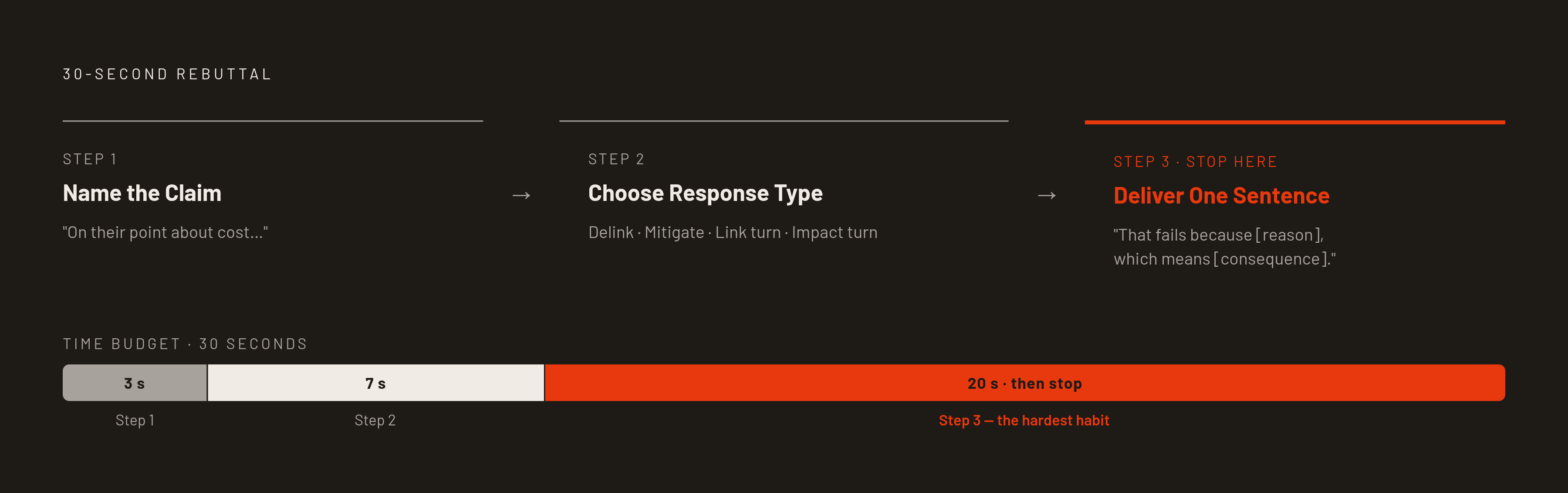
A 30-second rebuttal becomes reliable once it follows a fixed three-step sequence every time: identify the claim being answered, select a response type, deliver one clear sentence.
Step one is naming the claim before answering it. This costs roughly three seconds per argument and ranks among the highest-return habits in competitive debate, because an argument the judge did not record did not happen for scoring purposes. Signposting is simple in form: "On their second point about cost," or "On their claim about enforcement," said once, briefly, before the content of the response begins.
Step two is choosing which of four response types the rebuttal will use, and making that choice before the sentence starts. A delink argues that the opponent's claim never actually connects to the impact they're claiming, the road goes nowhere even if every step along it is true. Impact mitigation argues that the finish line itself isn't real: the consequence is overstated, isn't unique to their side, or doesn't apply in this round. A link turn argues that the opponent's own evidence actually supports the other direction. An impact turn argues that the outcome they're describing, assumed to be bad, is actually good, or at least less costly than what's on the other side of the round. Knowing which of these four a response will use before speaking is what makes the sentence come out clean. The decision has already been made; the mouth is just executing it.
Step three is delivering one sentence that carries out the chosen response type, and then stopping. A useful pattern for that sentence is: "That argument fails because [reason], which means [consequence for the round]." The hardest part of this step for newer debaters is the stopping. The instinct is to keep talking past the clean sentence, and a second, weaker sentence tacked onto a strong one only dilutes it. The close of a response is a short phrase that tells the judge what to do with the argument now that it's been answered, something like "so their second contention has no impact.
Strung together, the full sequence looks like this: "On their point about cost, their evidence predates the current mechanism entirely, so the link doesn't hold, which means their cost impact drops out." Three moves, one breath, under thirty seconds.
Attacking the strongest part of an argument, not the easiest
Speed only pays off if the rebuttal lands where it actually does damage, and the most vulnerable point in most arguments is the link, not the impact. Newer debaters gravitate toward impacts because impacts are vivid and easy to describe. More experienced debaters go after links, because links are where cases actually break down. An opponent's impact can be dramatic and still be irrelevant if the connection between their evidence and that impact never held.
When a link is weak, it deserves sustained pressure rather than a single mention, because most rounds are decided on the strength of links, not the size of impacts. Attacking a link is also faster to execute than contesting a broad claim about consequences, since it targets one specific connection: "their evidence is from a date that predates the mechanism they're describing," for instance, rather than a sprawling argument about downstream effects. Knowing when not to swing at all matters just as much. Conceding an argument that doesn't actually threaten the round frees up time for the arguments that do, and a judge reads a clean concession of a harmless point as confidence. Resisting the urge to answer every sub-point, and collapsing instead to the one or two arguments that decide the round, is what separates a debater reacting to pressure from one controlling it.
Preparing blocks before the round so the framework runs automatically
The three-step framework only runs fast enough to matter once it has already been drafted once, before the round, in the form of a written block. A block is a pre-written set of responses to the arguments an opponent is most likely to run. For each major argument planned for the round, the exercise is to write out the two most likely counter-arguments an opponent will raise against it, then write the one-sentence comeback to each.
The block doesn't need to be memorized word for word to be useful. Drafting it once deposits the sequence into memory, so that when the moment arrives in round, the words are already there to reach for. Writing out responses to the two most likely opposition arguments for each major point a debater plans to run ranks among the highest-leverage uses of prep time before a round starts. Preemption extends the same logic in the other direction: naming the opponent's strongest likely argument and defusing it before they ever raise it. The strongest version of this move states the opposing case better than the opponent will state it themselves, and then defeats that version. Raising an opponent's best argument first and refuting it neutralizes that argument before it lands, and signals to the judge that the debater already knew what was coming. Block-writing is also where the four response types get tested in advance. Forcing a choice between delink, impact mitigation, link turn, and impact turn while writing the block lets that choice arrive instantly in round.
Closing the Rebuttal Speech
Compressing individual responses to thirty seconds apiece only pays off if the time saved gets spent somewhere that matters, and the final stretch of a rebuttal speech is where a round is actually won or lost on the scorecard. The last thirty seconds should not add another response. They should tell the judge directly why the debater has won, naming the two questions the round turns on and explaining why each one resolves in their favor. That is the structure a scorecard is actually filled in against.
Running out of time in the middle of a response is a far worse outcome than finishing a few seconds early with a clean summary, so the close has to be budgeted for before the body of the speech even begins. The 30-second warning on a visible timer functions as a clear signal to shift modes, from responding to weighing. At that mark, the job is to explain why the responses already delivered are enough to win. The crystallization formula is simple: name the two voting issues, the two questions the round actually turns on, and deliver one sentence on each explaining why that side wins that question. The close should land on the strongest argument in the speech, not whichever one happened to be reached last. This is the payoff for all the discipline built into the earlier steps: a debater who kept every response to a single sentence has thirty full seconds left over to spend on the only part of the speech a judge weighs the whole round against.
Drilling this framework in live, timed practice
Understanding the three-step framework is not the same as being able to execute it. The framework collapses under real time pressure until it has been drilled under conditions that actually replicate the stress of a live round. Practicing with a running clock and a real listener ranks among the highest-leverage uses of prep time, because the point is to feel the timing in the body before it counts for anything.
Debate practice resembles chess training more than it resembles classroom discussion. It requires a real opponent, a real clock, and a real score, not just reflection or note-taking after the fact. One specific solo drill: write a thirty-second weighing block for the strongest argument in a case, then time a spoken delivery of it aloud. Speaking it aloud against a timer is what builds the muscle memory. Rereading it silently does not. A weekly rhythm reinforces the same habit over time: pick three topics each week, argue one from the affirmative side, one from the negative side, and one on a topic genuinely unfamiliar. The third of those is where real calibration develops, because it forces the three-step sequence to work without the comfort of prior expertise. Live one-on-one rounds judged by AI close the feedback loop on all of this. Every completed round produces a written decision scoring logic, response quality, clarity, and persuasion, and citing what was actually said in the round, so a debater can see precisely which responses landed and which were too slow or too thin to register.
Reading an AI judge's decision to improve your next rebuttal
A scored decision only sharpens the next rebuttal if the debater knows how to read it against the specific choices made in the moment. A well-structured decision breaks the score into component dimensions, argument quality, responses to the opposing case, and structure and clarity, so the debater can trace a weak score back to a specific point in the three-step framework rather than treating the feedback as a single vague verdict.
A low score on responses to the opposing case usually points to a failure at step two or step three: either the wrong response type was chosen, the link that should have been attacked was left standing, or the response was delivered without the one-sentence close that tells the judge what to do with it. A low score on structure and clarity usually points back to step one: the signposting was missing or unclear, and the judge could not record which argument was even being answered. The reason-for-decision explanation attached to the verdict identifies which clash actually decided the round and flags whether any late responses arrived too late to be weighed, which tells the debater exactly where the next round's time budget needs to shift.
Sources
- Debate Rebuttal Timer — 2 Minute Warning Timer
- Responding to Arguments: Rebuttals & Blocks — Atlanta Urban Debate League
- 4: Clash—The Art of Refutation and Rebuttal - Social Sci LibreTexts
- Debate Structure — Atlanta Urban Debate League
- © National Speech & Debate Association PUBLIC FORUM AND CONGRESSIONAL DEBATE