How Streamers Choose Opponents From the Leaderboard Pool
Leaderboard rank is just the first filter in a three-gate selection process.

A challenger who finishes high on a debate leaderboard has not completed the journey. They have entered it. The path from a ranked position on the board to an actual seat in a live broadcast runs through three sequential gates, and each one eliminates candidates regardless of how well they performed at the previous stage. Understanding those gates changes how a serious debater should train.
How the leaderboard-to-live-seat pipeline actually works
Most people who climb a debate leaderboard treat a high rank as the finish line. The rank is not the destination. It is the entrance to a selection process with two more gates standing after it, and those gates are not decorative. They are filters, each one capable of ending the process on its own.
The pipeline is sequential, not parallel. A candidate who clears the first gate but fails the second does not get an invite. A candidate who clears the first two but fails the third does not get an invite either. This is the distinction that most hopeful climbers miss, because the leaderboard is public and visible while the other two gates are not. Rank can be tracked, measured, and optimized against. The rest of the process happens quietly, behind the structure of the broadcast itself.
Debatable makes the pipeline explicit. Leaderboard success puts a user in consideration, style fit determines whether the way someone argues suits the show, and availability, both sides being able to make the live slot, is the final gate before an invitation goes out. The platform's live judged rounds generate the ranked performance that feeds the first filter, making the entire sequence transparent to anyone climbing toward a creator matchup.
The practical meaning is straightforward. A high finish gets a challenger considered, but it does not guarantee a matchup. It comes down to whether the creator is free and the topic fits. The serious challenger is not the one who climbs highest. The serious challenger is the one who understands what all three gates are actually testing.
What the leaderboard actually measures and why rank is the right first filter
Rank earns a challenger consideration because it is the one signal in the entire pipeline that is produced entirely by judged performance under competitive conditions. It is not built from follower count. It is not built from personal connection. It is built from completed rounds, scored verdicts, and the accumulated weight of wins against real opponents over time.
That is why rank functions as the right first filter. Rank tracks volume of quality performance over time, which makes it a reliable proxy for whether a challenger can hold their own on a live broadcast. A creator looking at the board does not need to wonder whether a candidate can speak under pressure or respond to counter-argument. The rank already answers that question, because the rank was earned by doing exactly those things repeatedly.
Every completed round on platforms like Debatable produces a scored verdict, making rank a measurable record of competitive competence rather than a popularity contest. This is the legitimating logic of the entire pipeline. The first gate has to be trustworthy, or everything downstream collapses. Rank survives as the right mechanism because it cannot be gamed through social capital the way a follower count or a network of friends can.
But rank has a specific and important limit. What rank does not capture is the character of how someone argues. Aggressive or methodical, broad or specialized, high-energy or deliberate: none of that shows up in a position on the board. Two challengers can hold identical conditional ranks and argue in ways that could not be more different from each other.
This gap is not a flaw in the system. It is why a second filter exists at all. Rank tells a creator that a challenger can compete. It says nothing about whether that challenger will produce the kind of broadcast the creator is actually trying to make.
Style fit: what streamers are actually reading for when they look beyond rank
Style fit is the gate that most high-ranked challengers do not see coming, because it operates on criteria that are never posted on the leaderboard. A challenger can track rank, optimize for it, and celebrate it. Style fit is different. It is evaluated by someone else, for purposes the challenger has not seen.
Debatable names it plainly. Style fit means the way someone argues suits the show. The creator is asking whether this person's arguing style will produce the kind of broadcast the creator's audience expects. That question has nothing to do with who wins more rounds on the board. It has everything to do with what a live audience will experience if this particular person sits across from the creator on camera.
The implication is concrete, and it explains why two challengers with identical ranks often receive different outcomes. A streamer whose show is built on rapid back-and-forth needs a challenger who can keep pace, not one who excels at long structured speeches. A creator whose audience wants intellectual rigor needs someone who builds cases, not someone who relies on rhetorical pressure. Topic specialization matters too. A challenger who debates economic policy effectively may be a poor fit for a show focused on social and cultural questions, even if the rank is identical.
The streamer's stated goal shapes the filter. The audience-persuasion model that live debate culture is built around means the creator is selecting for someone who will make the argument interesting to watch, not just someone who will be hard to beat. A challenger who wins every round through relentless preparation but makes for dull viewing is a worse choice than a challenger who loses a few rounds but produces compelling broadcast moments. The creator is curating a show, not administering a fair tournament.
The rounds that build rank are also the rounds that build a visible arguing style, and that style either fits a creator's show or it does not, independent of the score. A challenger's pattern of responses, pacing, and argumentation depth across live judged debates becomes the signature that streamers evaluate for show compatibility. This is the part that makes style fit feel subjective to the challenger but is actually quite predictable once a person understands what the creator is producing. The puzzle of style fit dissolves once the broadcast is seen as the product.
Availability: why the third filter eliminates more candidates than the first two combined
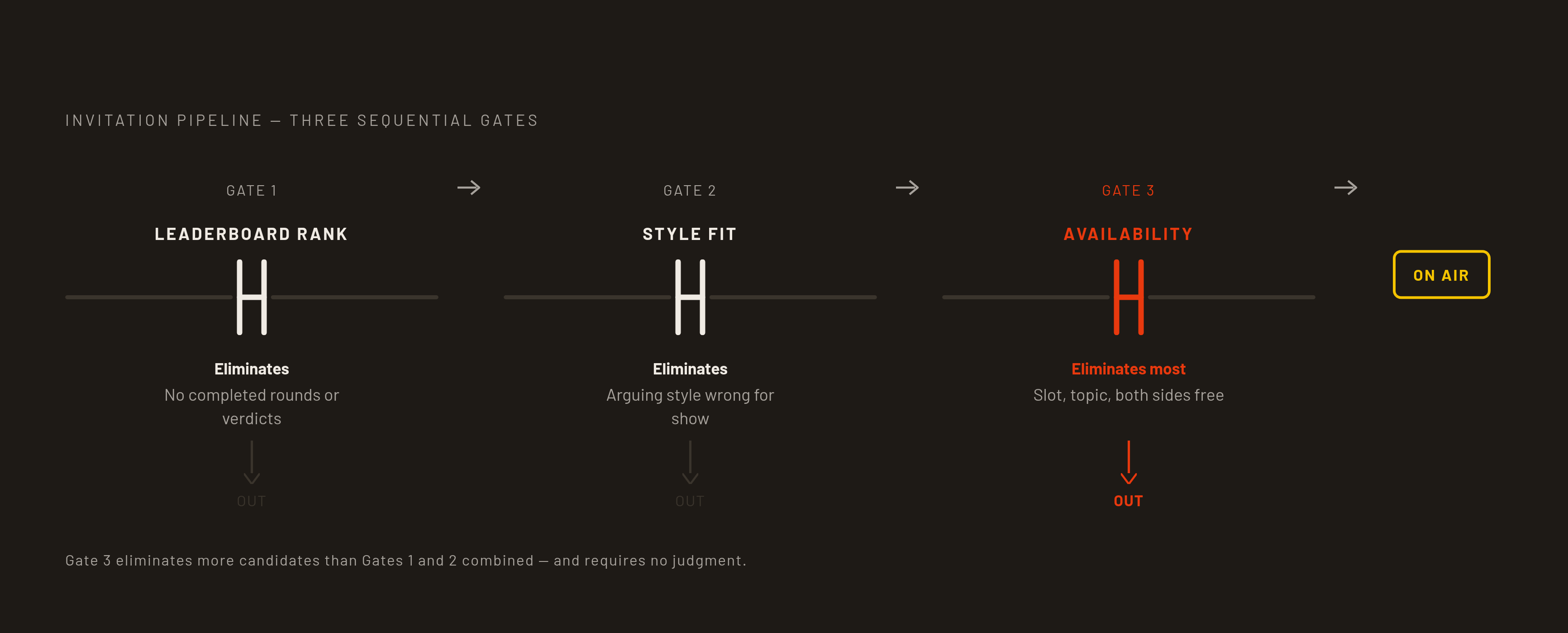
Availability is the gate that requires no judgment from the creator, yet it is where most qualified challengers lose their shot. The reason is structural. A live broadcast has a fixed time, and both sides have to be present at that time. No amount of rank or style fit can override that fact.
Debatable states this directly. The invitation goes out only when a creator matchup fits a topic a challenger argues and a time the challenger can make. Rank and style fit still matter, but none of them lead to an invite if the slot does not work. This is not a preference on the creator's part. It is a constraint built into the nature of live programming itself.
The elimination logic operates on several levels at once. A creator matchup is not a standing offer. It happens when a creator decides to run one, on a schedule the creator controls. A challenger who peaks on the leaderboard between matchup events, or who cannot make the scheduled time, passes through the first two gates and falls at the third. Topic availability compounds the timing problem. A challenger who ranks highly on economic questions is not a fit for a matchup built around a social or technology topic, even if the timing is perfect.
This is the quiet filter, the one that seems mechanical and therefore less interesting than style fit or rank. But that mechanical quality is exactly what makes it so eliminative. Rank and style fit reward consistent performance. Availability punishes a single absence. A challenger who was ready in March but not in June does not carry March's readiness into June's matchup. The window opens when it opens, and the challenger is either inside it or not.
The practical consequence follows directly. Staying available, maintaining rank across multiple cycles rather than peaking once, is the most reliable way to survive the third gate. A single peak performance is fragile. A continuous presence is resilient. The challenger who understands this stops asking how to climb higher and starts asking how to stay ready.
What the pipeline means for how a challenger should actually practice
Because each gate tests something different, training that targets only rank, grinding wins without attention to style or topic range, is the wrong preparation for the full selection process. It is not merely incomplete. It is misdirected, because it optimizes for the first gate while remaining blind to the second and third.
Training for the first gate is the most straightforward. The path is consistent volume of judged rounds, which builds the win record that puts a user in the consideration pool in the first place. This is the baseline. Without it, the other two gates never open.
Training for the second gate requires broader work. Debating a wide range of topics against real opponents, not just topics the challenger already favors, builds the visible style that will either match a creator's show or not. Arguing the harder side of topics a challenger disagrees with builds the argumentative flexibility that style fit demands. AI voice rounds let a challenger practice immediately, hear real pushback, and read a decision without waiting for a live opponent, which compresses the feedback cycle for style development. Each of these rounds leaves a trace: a performance pattern, a set of response habits, a pacing signature. That trace is what the second gate reads.
Training for the third gate is about persistence. Staying in the pool requires maintaining rank over time, not peaking once, which means treating debate practice as a habit, not a sprint. Live 1v1 rounds against real opponents serve both rank-building and availability. Each completed round keeps a challenger active and visible on the board. A challenger who debates every week is in the pool continuously. A challenger who debates intensely for one month and then disappears is out.
The cost question is real, and it shapes what kind of challenger can even attempt this kind of preparation. A full training regimen across all three gates requires volume, and volume has traditionally required access to a school team or an institutional program. Debatable's Individual plan at $10 a year includes 120 AI voice minutes each month, which makes the volume of practice rounds needed to train across all three gates accessible without a school team or institutional backing. That price point matters because it removes the access barrier that has historically separated serious debaters from everyone else.
The honest constraint the pipeline imposes on even the most prepared challengers
There is a limit to what preparation can buy. Passing all three gates requires a challenger to be ready on rank, style, and timing simultaneously, and the creator's schedule, not the challenger's preparation, determines when that window opens. A challenger can train perfectly and still miss the window through no fault of their own.
Debatable is clear about this. A high rank does not guarantee an invite. It depends on whether a creator takes part, the topic, and who can make the time. That is the honest constraint. The pipeline is not a meritocracy in the pure sense, because merit cannot control the calendar. It can only position a challenger to be ready when the calendar happens to open.
The honest implication follows. The pipeline rewards persistence over a single peak performance, because a challenger who trains continuously across all three dimensions is more likely to be ready when the window opens than one who optimizes for a single moment. A peak is a bet on timing. Persistence is a bet on probability. The persistent challenger might not be invited this cycle, but the persistent challenger is still in the pool when the next cycle starts.
What a challenger can control is substantial, even if the outcome is not guaranteed. The rank they carry into any given matchup cycle, the style they have built across a range of topics, and the habit of staying active on the board are all within reach. The rest is timing. When the window opens, those three things determine whether the challenger steps through it.
The broader truth the pipeline embodies is larger than any single platform. Live, judged debate against real opponents is the only way to build all three qualities at once, because rank, style, and readiness are not separable in practice. They develop together or not at all. A debater who chases one while neglecting the others is not preparing for the pipeline. They are preparing to be eliminated by it.